

Solar Panel Cleaning in San Antonio
Panel cleaning that takes the shade off the glass, without scratching it or voiding a panel warranty. No soaps, no abrasives, no pressure washers.

Top Four Reasons Panels Get Dirty
- Central Texas Dust and PollenDust, cedar and oak all settle into a film that a light rain does not touch. There are two pollen seasons here, not one — more on that below.
- Sprinkler Overspray Leaves Mineral DepositsHard water hitting hot glass dries into scale that will not wash off. Irrigation aimed anywhere near an array is one of the worst things for it.
- Birds, Bats and What They Leave BehindDroppings do not rinse off, and a spot dense enough to shade a cell can drag down a whole string through the bypass diodes.
- Debris Collects at the Frame EdgeThe bottom rail of every panel catches a line of grit that holds moisture against the seal and shades the lowest row of cells first.
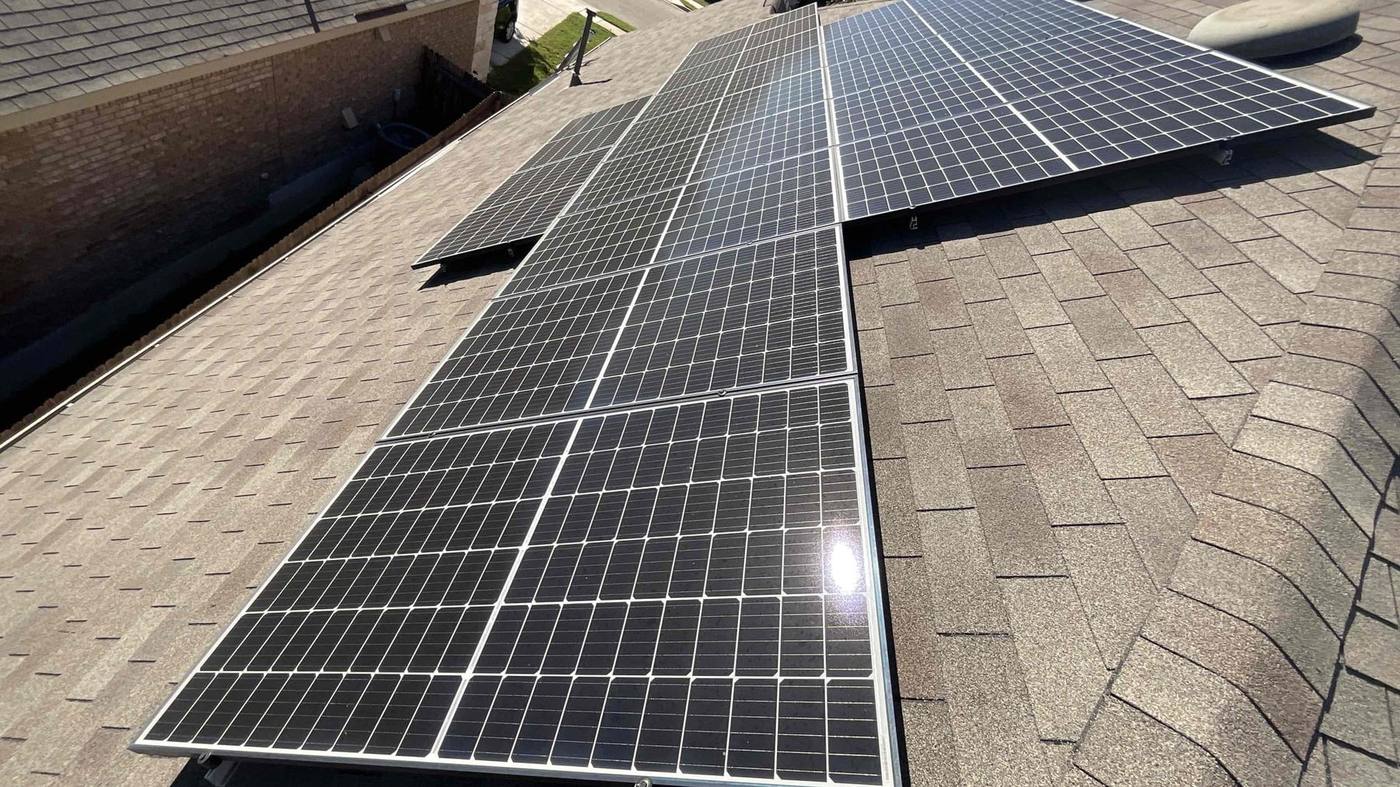
Central Texas Has Two Pollen Seasons, Not One
Cedar comes first. It releases from mid-December through February and peaks around the middle of January. It is fine enough that you will never see it on the glass from the ground — it films rather than coats, and a light rain does not move it. Around San Antonio it is heavy, and it runs north into the Hill Country.
Live oak is the opposite. It starts in late February, runs through April and peaks in March, and it is heavy enough to leave a visible yellow layer on your car, your patio and your windows. Live oak follows it straight through the spring here. Whatever you have been wiping off the car is on the array too. The difference is that nothing up there gets wiped down.
Cedar tapers off in late February exactly as oak ramps up. Back to back, that is roughly five months of something landing on your panels.
And a dirty panel is not a dimmer panel. It is a partly shaded one. Pollen does not land evenly. It films rather than washes off, bonds with dust and settles in patches and streaks, heaviest along the bottom edge of each frame. So you do not get a panel producing slightly less. You get most of a panel producing normally and part of it shaded.
Shade, electrically, is resistance. A shaded cell stops generating, but the cells around it keep pushing current through it, and something that resists current turns it into heat. That is a hot spot, and it sits there for as long as the dirt does. The stronger the sun, the more current there is to push — so the same patch of pollen that was minor in December becomes a real hot spot in April.
That is the cost that matters: not the production you lost in one month, but the years of running hot that age cells, solder joints and the electronics on the back of the array. We are not going to quote you a percentage. Anybody who does is guessing.
Does Rain Clean Solar Panels?
- Doesn’t the rain just wash them off?Not really. Rain moves loose dust. It does not lift pollen, because by the time the rain arrives the pollen has already wetted and bonded to the glass. Anyone who has watched a storm blow through in the middle of cedar season and then looked at their car already knows the answer.
- Can rain make it worse?Sometimes. A light rain wets the pollen without carrying it away, and then the sun bakes it back onto the glass. That cycle is what turns a dusting into a film.
- What about the water itself?Rain is cleaner than your sprinklers, but it still dries on hot glass and leaves behind whatever was dissolved in it. Same mechanism as irrigation overspray, just gentler.
- Where does the runoff go?Down the panel and into the bottom edge of the frame, where it stops. That is why the lowest row of cells is usually the dirtiest part of an array, and the first to shade.
- So when does rain actually help?A long, heavy downpour on an already fairly clean array will rinse loose grit off, and that is genuinely useful. What it will not do is remove bonded pollen, mineral scale or bird droppings — the three things that actually shade cells.
When Your Panels Actually Work Best
Your panels do not produce the most in July. They produce the most in spring and autumn — bright days, the sun high enough to matter, and the air still cool enough that the panels are not fighting their own temperature. Solar cells lose efficiency as they heat up, so a clear seventy-five degree day in March will beat a blazing one in July.
Which is the same enemy in a different place. Soiling makes hot spots on part of a panel. Summer makes the whole panel hot. Both are heat, and heat is what a solar system quietly loses to — in output while it is happening, and in wear over the years.
So a clean array in spring is the best your system ever performs: cool air, strong sun, nothing shading the cells. A dirty array in July is the worst of both — hot everywhere, with hot spots on top of it.
And here is the awkward part. Early spring is your best production stretch of the year, and March is also peak oak. Cedar has been building since December, oak is at its peak, and the weather has finally turned. The one window when your array could be doing its best work is the window it is most heavily coated.
So Why Not Wait and Clean Both at Once in May?
Two reasons, and neither of them is about the panels looking nice.
The first is the spring window. Wait until May and you have spent the best production stretch of the year running under cedar and oak. Clean after cedar instead — late February, before the oak arrives — and the array is clear for the part of the year it performs best.
The second is what cedar does while it sits there. Cedar lands in December. Wait until May and that film has had four or five months on the glass, through every dew, every fog and every cold snap. Pollen and moisture together do not stay dust — they bond, and they paste onto the glass. What would have rinsed off easily in February turns into something that takes real work to lift, and some of it does not come off at all.
That is the honest case for two visits instead of one. Not twice the cleaning for its own sake — one before the spring window so you actually get it, and one after the oak drops so the array goes into summer clean and nothing sits long enough to set.
Top Four Solutions to This Problem
- We Will Not Quote You a PercentageAnyone who tells you a clean recovers a specific number is guessing — it depends on your glass, your pollen and your roof. What a clean reliably does is take the shade off the cells, which is what was heating them.
- Pure Water and Soft Brushes OnlyNo detergents, no pressure washers, no abrasives. The anti-reflective coating on modern glass is easy to ruin and impossible to put back.
- Inspect the Array While We Are Up ThereA cleaning visit is the best look anyone gets at your roof. We check for damaged glass, loose clamps, chewed wire and critter activity while we work.
- Set a Cadence That Fits Your SiteA house under oaks needs a different schedule than an open lot. We tell you what yours actually needs rather than selling everyone the same plan.
One Cleaning a Year, or Two?
It depends on which trees you have, not on how big your system is. Most lots around San Antonio get both. If yours does, your array gets coated twice a year by two different things at opposite ends of the calendar.
That is the whole reason there are two memberships rather than one. It is not an upsell — it is which trees you happen to have.
- Platinum — $55/moCedar only. One cleaning and inspection a year. 5% off on-call maintenance. Two free basic maintenance trips if needed.
- Platinum Plus — $75/moCedar and oak. Two cleanings and inspections a year. 5% off on-call maintenance. Two free basic maintenance trips if needed.
Around here most lots have both, so Platinum Plus is usually the honest answer — one visit after cedar, one after the oak drops. If your lot is clearly one or the other, Platinum is enough and we will tell you so. See both memberships →

Let’s get your solar working again.
Book online in under two minutes, or call and talk to someone in Texas.